


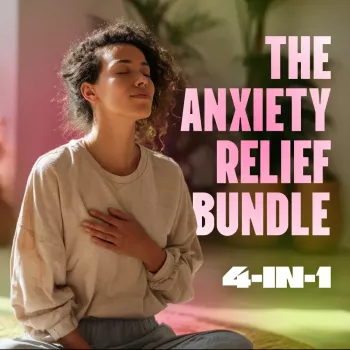
The Anxiety Relief Bundle: A Gentle Path to Calm

When anxious thoughts show up, deciding what to do next can feel like another task on your list. A simple, flexible routine may give you a place to start, without asking you to ignore how you feel or follow a perfect schedule.
Our The Anxiety Relief Bundle: A Path to Calm brings together mindfulness exercises, positive-thinking resources, a printable checklist, and a course outline. These self-guided resources are designed for reflection and practice, not as a promise of relief or a replacement for professional care.
What’s Included in the 4-in-1 Bundle
Each component offers a different way to approach your routine. You might use a mindfulness exercise to pause, turn to a reflection prompt when a thought feels difficult, or use the checklist to remember practices you want to revisit. The course outline can help you organize your exploration of the material.
| Component | How It May Support Your Routine |
|---|---|
| Mindfulness exercises | Make space to pause and notice the present moment. |
| Positive-thinking resources | Encourage a more balanced approach to difficult thoughts. |
| Printable checklist | Offer a way to keep track of selected practices. |
| Course outline | Provide a structure for exploring the material. |
You don’t need to use every component at once. Choose the one that feels most approachable, and let the others be available when you’re ready. The goal can be as simple as making a little room for reflection in a busy day.
Build a Gentle Mindfulness Routine
Start by choosing a comfortable moment to pause. You might notice the sensation of breathing, the support of your chair, or a few sounds around you. There’s no need to force your attention to stay in one place; if it wanders, you can gently return to whatever you chose to notice.
Keep the practice small enough to fit your day. A brief pause after a meal or before opening your email may feel more manageable than setting aside a large block of time. You can also try different points of focus. If paying attention to your breath feels uncomfortable, noticing your surroundings may be a better fit.
Mindfulness does not guarantee that anxiety will stop, and it may not feel comfortable for everyone. You can pause or change an exercise whenever you need to. The National Center for Complementary and Integrative Health offers more information about mindfulness, including its benefits and safety considerations.
Practice More Balanced Thinking
Positive thinking doesn’t have to mean insisting that everything is fine. A more useful approach may be to acknowledge a difficult feeling while considering whether there’s another realistic way to understand the situation.
For example, if you’re worried about an upcoming conversation, you might notice the thought, “I’ll say everything wrong.” Rather than replacing it with a promise that the conversation will go perfectly, you could try: “I can prepare what I want to say, and I can take a moment to respond.” The alternative leaves room for uncertainty without treating the worst outcome as certain.
When you want a starting point, ask yourself: What is one kinder, more balanced way to view this situation? You can write down an answer or simply consider it for a moment. If no alternative comes to mind, it’s okay to return to the question later.
Use the Checklist and Course Outline
The printable checklist can be a practical reminder of exercises you want to return to. You might mark a practice after trying it or note which ones feel comfortable. Instead of treating the list as a test, use it as a way to notice what you’ve explored.
The course outline offers another way to bring structure to the bundle. You can look it over, choose a place to begin, and move through the material at a pace that works for you. Returning to an earlier topic is just as valid as trying something new. If your needs change, your routine can change too.
Some people find it helpful to connect a pause with an everyday activity. For example, you could take a moment to notice your surroundings while washing your hands. Our 500ml Glass Soap Dispenser Bottle is an optional household item for that space; it isn’t part of the bundle or necessary for the practice.
Choosing Support That Fits Your Needs
Our team sees the bundle as an option for you if you’re interested in self-guided mindfulness and reflection. Consider whether you prefer having several resources to explore and a checklist to help you keep track, rather than a single exercise. You can make the routine your own without expecting every practice to work the same way for you.
The bundle’s listed price is $106.99. Visit the product page for current details and pricing. If anxiety is persistent, distressing, or interfering with daily life, consider speaking with a qualified health professional. The National Institute of Mental Health provides information about anxiety disorders and options for getting help.
FAQ
What is included in The Anxiety Relief Bundle?
The bundle includes mindfulness exercises, positive-thinking resources, a printable checklist, and a course outline.
Can the bundle replace therapy or medical care?
No. It is a supportive self-guided resource, not a substitute for professional assessment or treatment.
How can I start using the bundle?
Begin with one manageable practice, then use the checklist and course outline to organize a routine that feels comfortable.













Leave a comment